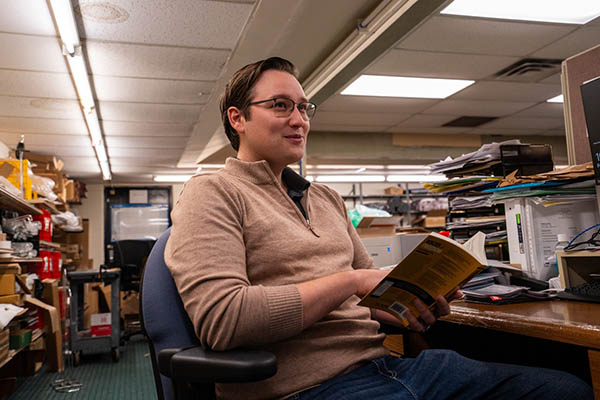
Your heart is soaring. It’s your first-ever semester at Aquinas, and your classes begin next week. Orientation has come and gone. Placement tests are done. And you’ve already made new friends. All that’s left is to walk into the bookstore and pick up your order. The lower floor of Wege greets you with the chatter of your classmates and the deep scent of old pages. But when you arrive at the register, that happy feeling shatters.
The number on the screen is much larger than you’d anticipated— too large, even. You still need to afford groceries for the week. So you say to the cashier, “Sorry, I’ll have to put that one back,” and you hope that you’ll still be able to follow along in class without it.
You turn away, trying to hide the heat that’s risen to your cheeks, but a kind voice tells you to wait a moment. He says that it’s going to be okay, and he informs you that you can still have the book you need.
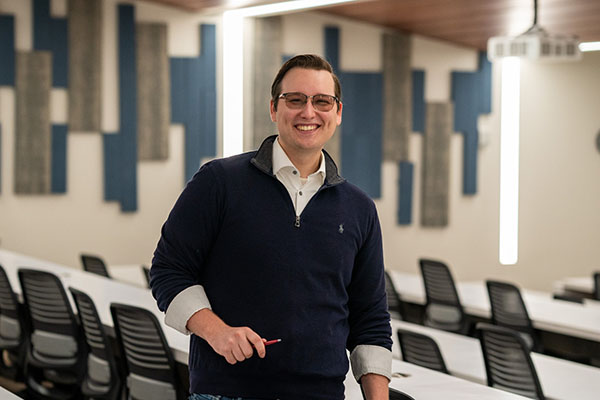
That kind voice belongs to Allan Wisz, a continuing education student, military veteran, history major and legal studies minor, and founder of the Wisz-Heitz Book Award, which aims to help students in situations like this cross the finish line. For Allan, this act of generosity is part of a much larger story and reflects the experiences and values that have shaped his life.
A Foundation in Service
Allan did not take the traditional path into college right after high school graduation. Instead, he chose to serve his country in the military, where he found fulfillment in his community and value in the structure that environment provided him.
“It taught me a lot. It was the best option for me at the time. I don’t regret it at all,” he shared.
Allan fit right in, and because he enjoyed it so much, he planned for a 20-year career there. So when he sustained an injury and was medically retired because he could no longer perform the physical duties his position required, he was heartbroken.
“I was losing everything. I was losing my career. I was losing my military family,” he shared, expressing just how difficult it was to transition from military service back into civilian life. It was a sudden change he never asked for, and it left him feeling deeply isolated.
“Your entire support community that you’ve had for years is just not around anymore,” explained Allan. “There’s not a cohesion of hard work going on. So it’s difficult. You lose part of that when you leave.”
Discovering a New Way to Serve
Shortly after his injury, he was positioned at the Airman Family Readiness Center (AFRC), where he and others in similar situations could find the support they needed. This could mean anything from education, life counseling, employment assistance, or financial counseling— all depending on the person’s needs. Allan was fortunate to receive support during this difficult time. But he also saw how bureaucracy could stand between people and the resources available to them. It was a frustrating reality, especially for those already facing challenging circumstances.
“I was like, this is hard. This shouldn't be this hard. People don't understand what they're writing and signing.”
Allan began reading and studying books on the Code of Federal Regulations (CFRs) to better understand what he was seeing. He found he enjoyed reading them, then learned that he could also review other people’s “packages” on their behalf and send them to the medical examiners, who would determine whether they were medically fit or needed to be discharged. In the process, he discovered a knack for parsing through the legal language.
“It was important to me to do something. I mean, not only for myself. I lost my usefulness. I was no longer in the military. Being anywhere, it's important to be useful. But yeah, everything I was trained to do I can no longer do. I wasn't me anymore after I first got hurt, and at least I could find a place to be useful again. So I think that was a big part of it.”
Ultimately, Allan’s desire to help others navigate the documents they were signing inspired him to pursue a new path. Returning to college would give him the opportunity to build on what he’d learned and continue serving others in a different way.
Charting a New Course Led by Values
That search for a renewed sense of purpose, rooted in service, eventually brought him to Aquinas, where he embraced a new community. While it wasn’t exactly the same as what he had left in the military, he expressed that many of the core tenets were similar: “Service before self, excellence in all you do, and integrity.”
“And that’s something that I grew up with in the military,” said Allan. “When I left, even talking to people felt kind of like a facade; it's cold. Everyone's directed at their own personal gain all the time. And I felt that that was different here at Aquinas.”
On his tour, he noticed that Aquinas fosters a culture of doing the right thing and promoting the common good both on campus and in the broader Grand Rapids community.
“It just felt like, walking around the buildings, everyone knew each other's name,” he recalled. “And the professors asked you, ‘Where is your life going? What are you trying to do? What interests you?’ And that was pretty important just to know that someone was trying to look out for you.”
Overcoming Anxieties and Planting New Roots
Although he found a welcoming community at Aquinas, Allan still had anxieties about returning to the classroom. As a continuing education student, he worried that his age would set him apart from his classmates and that he might struggle to keep up academically.
“Coming from a pretty poor GPA in high school, I was worried that I wouldn't be able to do well. And that's something that definitely changed. I knew when I walked into a couple of my first classes and was like, okay, I got it. The people care; they're here, and they make it pretty accessible.”
As Allan grew more confident in the classroom, he began cultivating meaningful relationships with his professors, the college staff, and fellow students. Some professors invited him to stay after class so they could get to know him better. Others praised his contributions and encouraged him to return for their more advanced courses in upcoming semesters.
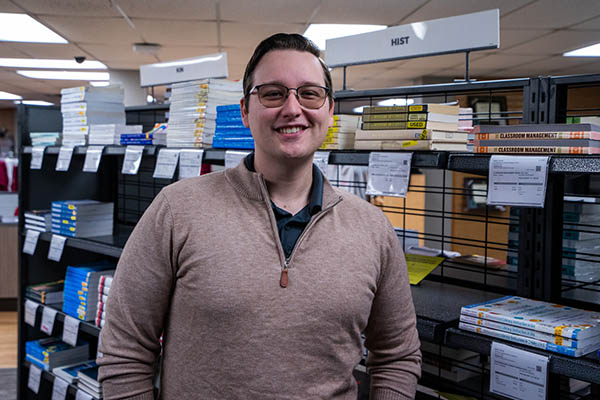
Outside of the classroom, Allan found another place to serve: the campus bookstore, where he landed a job working with Barbara (Barb) Heitz. There, he has flourished, becoming something of a mentor figure for the 17- and 18-year-olds who stop by the counter to purchase their books. He offers advice about everything from military service to navigating college life.
“I try to tell all the people, all the young adults here that I go to school with, that everyone around you is just a person,” said Allan. “We're all just trying to figure it out.”
 Ensuring that No Saint is Left Behind
In all his time working in the bookstore, Allan began to recognize a pattern in the stories these students were telling him.
Often, they had already received help with their tuition, but they didn’t realize just how much they needed to have set aside for books. He and Barb make a point to get the final cost of textbooks as low as humanly possible by showing students resources for buying used books, but in many cases, the hurdle of a few hundred dollars could mean the difference between staying in college or dropping out.
“To get a good grade is certainly something that every student here that I've talked to is capable of. But sometimes it's the access,” Allan explained. “That's why I started the book fund.”
It began with Allan purchasing books from his own pocket, one at a time. Then, Barb suggested another option: start your own scholarship and invite the wider community to participate. He has even reached out to local Grand Rapids businesses to build a greater network of support for his cause.
“Yeah, I mean that's certainly the military in me, but I try to instill it in all the people here as well— all the friends I've made while here at AQ. When you see a problem, you bring it up, and then you fix it,” he shared. “Something in the military was that even the strongest soldier takes a knee once in a while. When someone takes a knee, and you see that, you stand in front of them. You protect them from what's coming. I think it's our duty to shield the people next to us.”
A Special Shoutout for Barb
Allan’s commitment to recognizing others is evident in the very name of his scholarship. When it came time to choose a title, he didn’t hesitate to add her name, too, believing she deserved recognition for the role she played in bringing this initiative to life.
Allan first met Barb when picking up his own textbooks from the store. He always dropped by a little too early for his order to be ready, and Barb remembered his name and began greeting him. She noticed that he seemed to know what he was doing, so she encouraged him to apply for a student position with Aquinas. But after two weeks, she recognized his talent and arranged for him to get a job alongside her at Follett.
“So I got hired as a full-time member. And I don't work a ton, but I work enough to contribute some. And that's how it started. She was just kind of like, ‘Dude, you're coming to work here now.’ And I'm like, ‘All right.’”
Then, when she found him trying to help students afford their textbooks, she helped him find the right people at the college to work with him in establishing a scholarship.
“I wouldn't be here without Barb. I wouldn't be able to deal with some of the things without having Barb in my life as a boss and as a friend. I can't say enough good things about her,” said Allan. “And I just don't see a reason why I shouldn't give back. I mean, part of it is, I guess, trying to pay back all the people here that made me feel like I was in a community again.”
Allan’s Call to Serve
Allan hopes his scholarship inspires others to look for the places where they, too, can make a difference. He encourages alumni and friends of the college to visit campus, meet the people who make up the Aquinas community, and discover needs that might otherwise go unnoticed.
Contribute to the Wisz-Heitz Book Award