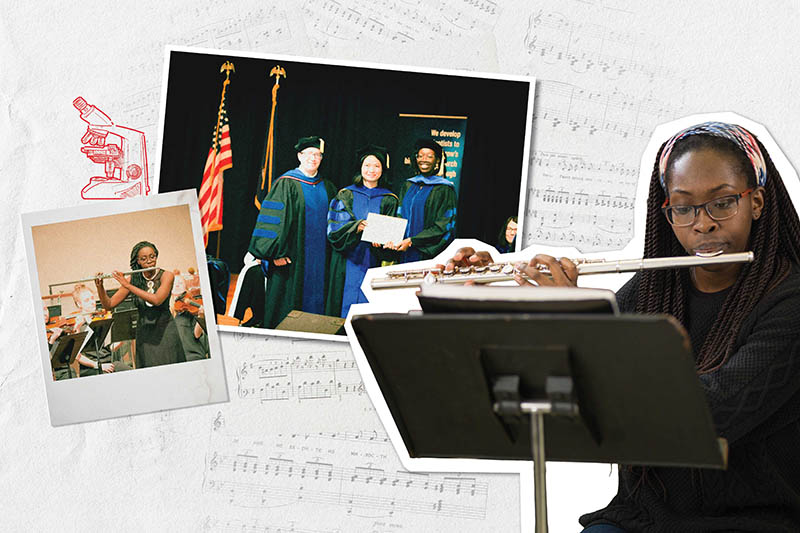
Svetlana Djirackor never set foot on Aquinas College's campus before she enrolled. She chose it from a website, beautiful forested sights unseen, and built a life there that took her from Kenya to a PhD studying ovarian cancer.
Finding Aquinas from Across the World
When Svetlana's parents encouraged her to study abroad rather than stay in Kenya,
a family friend's education consulting agency handed her a list of schools stretching
across the United States. She was accepted everywhere she applied. She picked Aquinas
from photos online: a small campus and the abundance of trees. A strong international
student scholarship cut her tuition in half, and the generosity of private donors
made her education affordable. She is still close with several of those donors today.
In fact, she had dinner with them during her time at Aquinas College, and a few reached
out to congratulate her when she and her husband married.
"It was very well thought out and deep. This just feels right," she said, laughing at how little planning actually went into it.
Her mother only had one worry going in: Aquinas is a Catholic institution, and Svetlana's own experience with Catholic schooling growing up had not been a good one. That worry did not last. Svetlana found the campus open to holding her own Christian faith alongside a Catholic mission. "I felt like I didn't have to compromise," she said.
A Coin Flip and a Calling
Long before Aquinas entered the picture, Svetlana was headed toward law. She spent
most of high school on a track toward history and government, not science. But her
sophomore year of high school forced a choice. Her school required students to take
a number of science courses; she was stuck between biology and physics. By her own
account, she was doing noticeably better in physics.
Her mother offered a different way to decide. "Whatever you do, you'll do it as unto the Lord," she told Svetlana, and pulled out a coin. Best two out of three. It landed on biology, a result Svetlana still calls illogical given her actual grades at the time. "It doesn't make any sense. You would pick the subject you're better at," she said. The decision held anyway, and she stuck with biology for the rest of high school.
It wasn't until Svetlana was preparing to leave for college that biology reasserted itself, this time tied to a real question. Her father was managing health issues, and Svetlana started reading about the vestibular hairs in the inner ear that help the body balance. Science had personal stakes now, not just a coin toss. "I really want to learn biology," she remembers thinking.
She now traces her entire scientific career back to that sophomore year coin flip. "I never would have known," she said, "if my mom hadn't said that, years ago." Her professors provided plenty of opportunities for her to grow in and out of the classroom. Svetlana has always been a curious and studious individual; Aquinas allowed her to grow deeper into who she was meant to be.
Two Majors, One Welcome
Svetlana grew up singing in Kenya's national music festivals, a competitive group
that combined choral performance with costumes, choreography, and physical endurance.
"Our training was running around a very rugged field and singing," she said. "If you
weren't loud enough, you had to run again, and you had to stay on pitch." She picked
up the flute at 15, after her high school music teacher challenged her to try something
harder than the recorder. Her parents scraped together $150 for her first instrument,
an amount she still marvels at given how little exposure to instruments she'd had
growing up.
She arrived at Aquinas planning to study music, but when she asked to double major in music and biology instead of taking biology as a minor, the answer was yes. "They said, okay, we'll work it out," she recalled. "I loved that they were very accommodating." She credits two advisors, one in each department: Mary Hurd for music and Dr. Larry Peters for biology, treating both paths as equally worth pursuing rather than steering her toward one.
Her biology advisor, Dr. Peters, gave her a summer research opportunity that became the foundation for her graduate school application. Their friendship has outlasted her time on campus. She still gets tacos with him when he's in town, and he attended her wedding. Her flute instructor, Carmen Maret, spent years patiently correcting techniques Svetlana had taught herself back home. That relationship held too. The two still play music together.
Finding Room to Ask Hard Questions
Faith at a Catholic institution was not something Svetlana expected to embrace so
fully. Raised Christian but not Catholic, she worried, along with her mother, about
how she would fit in. Instead, she found room to ask hard questions, including in
a theology course taught by a professor known campus-wide for being tough. She wrote
a final essay tracing the story of Jesus through scripture and received a perfect
score, along with a note that read simply: "You have conquered the assignment." Word
spread. By the following semester, students in the Writing Center were asking her,
specifically, for help with theology.
"I feel like faith is not something people expect to be part of a research life," she said. "But especially in the last couple of years, the Lord has been challenging me to live it out, because if you're convinced of something, you share it."
To Van Andel Institute
Her conviction carried her through a PhD at Van Andel Institute, where her dissertation research focused on ovarian cancer, specifically the supportive
tissue environment that allows tumors to grow and resist treatment. The project she
started with was scrapped in her fourth year, typically a moment of crisis for a doctoral
candidate. She began an entirely new study that March, and by September had enough
results to present at a conference, where she placed second among competing talks
and earned a $500 prize. She defended her dissertation in May and graduated in May
of 2026. A medical oncologist on her committee told her the work would be directly
useful in the clinic.
"You don't do your dissertation in a year and a half," she said. "It takes four to five years. But that's what happened, and I can't look at my life and say I orchestrated any of it."
She points to a string of moments she describes as too improbable to have planned: that sophomore-year coin flip, coming to Aquinas without ever visiting in person, and meeting her husband years later, someone she never would have crossed paths with had any earlier decision gone differently. Finishing her PhD, she said, also taught her something she didn't expect: that her worth was never really tied to the degree at all. "I'm so glad that I have worth outside of my accomplishments," she said. The liberal arts education she received at Aquinas, she added, taught her the value of not just lifelong learning, but lifelong curiosity—the willingness to follow a question wherever it leads, whether that's into a theology classroom, a music practice room, or a cancer research lab.
Roots That Reach Back
Svetlana still keeps in close touch with the Aquinas community that shaped her, from
her advisors to former roommates now scattered across the country. She's returned
to campus to guest teach alongside Dr. Hess and has spoken at Calvin and Grand Valley
as well. It's a spectacular full circle for someone who chose Aquinas from a handful
of photos online; the campus she never visited before enrolling is the same one she
now returns to on purpose, again and again.