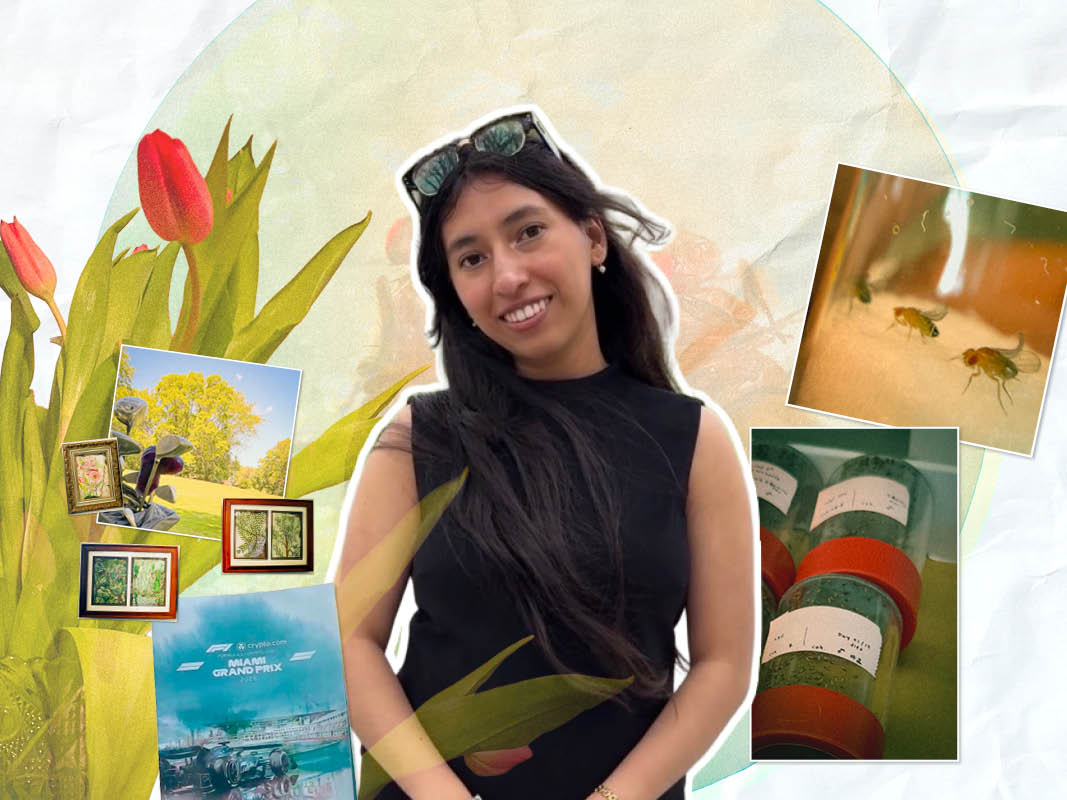
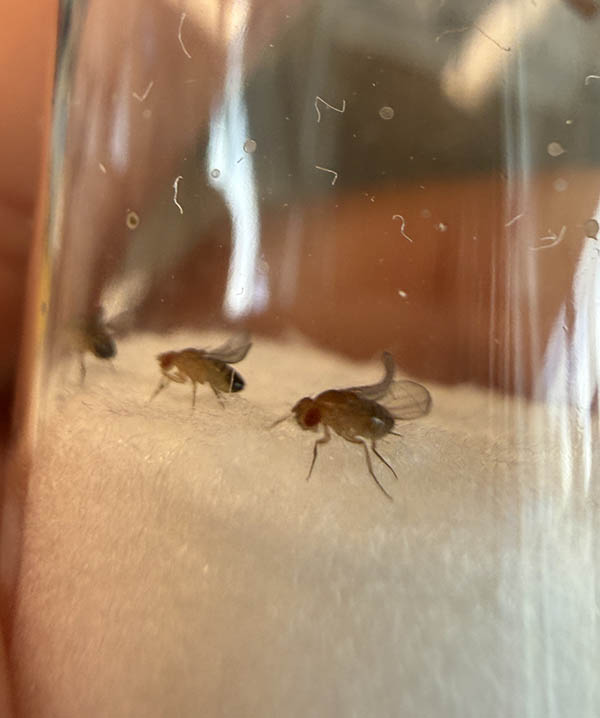
Fruit flies are generally not harmful to human health. They do not bite or sting, but they can certainly act as a nuisance. Most people try to eliminate these pests, but one Aquinas student has spent her summer breeding new populations of them.
Her name is Ariana Esquivel-Landero, a biology major, and no, she has no plans to release these into her home or anyone else’s. Instead, she conducted RNA research through an internship at the Van Andel Institute, focusing on a gene in fruit flies that has a human ortholog— a corresponding gene inherited from a common ancestor. Her goal was to better understand its potential role in autism spectrum disorder (ASD).
Learning to Think Like a Researcher
 Ariana expressed that her dream is to become a neurosurgeon and a researcher in the
neurodegenerative field. “So being able to be in a lab that deals with metabolism,
to have some sort of connection to the neuro department, is something that I’m super
happy I’ve had the opportunity to do,” said Ariana.
Ariana expressed that her dream is to become a neurosurgeon and a researcher in the
neurodegenerative field. “So being able to be in a lab that deals with metabolism,
to have some sort of connection to the neuro department, is something that I’m super
happy I’ve had the opportunity to do,” said Ariana.
This past summer actually marked the second research internship Ariana has completed at the Van Andel Institute. Last year, she worked closely with a research scientist (her mentor) to continue the research that a recent PhD graduate from that lab had worked on for her thesis.
After reviewing those findings, her principal investigator became particularly interested in a gene called domino, which served as the focus of Ariana's research for this most recent internship.
“So I have just been working nonstop throughout this summer on performing a ton of assays on the different fruit fly F1 generations and trying to see if my results from those assays, which are social distancing, spatial preference, and activity, can confirm what she previously saw while working on her thesis project,” explained Ariana.
Through this work, and with the help of her dedicated mentor and principal investigator, Ariana has honed communication skills, critical thinking skills, a sense of independence in the lab, and so much more.
“Unlike a typical internship where the mentor is holding your hand and guiding you directly through everything, he's noticed that I want the real experience of what it’s like to be a research tech, to be a graduate student, as well as a postdoc— anything of that nature. He knows that I really want to learn what it’s like to have some guidance, but the majority of the time be the one who makes the big decisions, the one who struggles and perseveres,” she explained. “And through that type of mentorship, I’ve actually been able to grow as a communicator in science.”
At the very beginning of both internships, Ariana shared that her mentor asked her what kind of experience she wanted: intern or grad experience, constant guidance or independence with help when she needed it. From the very beginning, she established that she wanted the real experience. And even though she still needs to update her colleagues on her project or assay and asks for help when she needs it for analyses, she feels she’s grown more independent through this internship thanks to her mentor’s incredible guidance.
“Even in a meeting with my PI, they’ve said that more recently they've noticed that I’ve been thinking much more like a graduate than an intern, which is such a huge compliment. Because it shows that I’m actually growing in my internship.”
A Chance Discovery Leads to the Lab
Ariana didn’t originally know that she would find herself at the Van Andel Research Institute. She knew she wanted to be a researcher and a neurosurgeon, but when she first started looking into opportunities in college, her heart was set on a part-time clinical job at Blodgett.
The hours for that position unfortunately didn’t line up with her class schedule. But luckily, Grand Rapids, as the second largest city in Michigan, has many, many great places for young professionals to start their careers.
“One day– I vividly remember this,” she shared. “I was driving down Division. And on my drive towards my previous high school, I saw this huge building. Originally, I thought it was the Butterworth Hospital, but it turns out it was a Van Andel Institute, the actual research institute.”
While she didn’t yet have enough experience for the research tech positions, as many of them required a bachelor’s degree, she did land a job at the Education Institute. She has worked there for just over two years, and this, as a stepping stone, helped her build both the experience and connections she needed to land her internship this past summer, as well as the internship that preceded it.
“They started to tell me, ‘Hey, you should apply. You should do this for real.’ And I applied,” she shared. “I actually didn’t think I was going to get in because I still didn’t have much research experience at that point. Ultimately, I was able to receive an interview with the lab that I’m currently in. Ever since then, I’ve been able to build connections and be more involved with the research side of things.”
Building a Foundation for Success at Aquinas
Ariana expressed how deeply valuable it has been for her to build her foundation in a place like Aquinas, where classes are small, and she can receive one-on-one support. Moreover, she cites the academic rigor of her classes as being the place where she learned how to manage her time effectively, a skill which she has seen directly translate to her internship.
“I feel like, with the way everything is set up at Aquinas, and because I usually do take 16-credit semesters, plus honors, having that workload has taught me to be able to balance everything a lot better,” she explained.
On top of her full-time internship, Ariana also spent the summer painting and golfing. Even though Van Andel is certainly keeping her busy, she stressed how important it has been to take personal time and enjoy the summer before classes started up again.
Where the material is concerned, she is confident that the content in her classes has prepared her exceptionally well for the work she’s doing at Van Andel.
“A lot of the classes [At Aquinas] have been able to teach me the fundamentals of science, stuff that I’ve noticed some students from other institutes don’t know much about. But at our specific school, what I’ve been able to learn, I’ve been able to, most of the time, apply directly to my research.”
Her ability to communicate scientific principles in terms that non-scientific audiences would be able to understand was one such skill that she singled out as especially important. After her first summer internship, she began presenting at Aquinas’ research symposiums, which have helped her “become a more effective communicator in science.”
She also shared just how instrumental the various student organizations at Aquinas have been, particularly the Pre-Health/AED club and the Aquinas Chemistry Society (ACS). “A lot of that relationship building has allowed me to become better at getting out of my comfort zone and talking with more people around the institution— and also to build those connections,” Ariana reflected.
“So yeah, I feel like Aquinas has done such a great job of preparing me academically and just in various real-world, real-life skills, so that I can succeed, not just at Van Andel, but anywhere in life. I’m using a lot of those skills in other places.”
The Things We Love Tell Us What We Are
The joy Ariana feels for her research is palpable as she speaks, especially when describing one early experience she had in conducting research: performing her very first RNA and polar metabolite extractions from Drosophila (fruit fly heads).
The purpose of this test run was to give her a little more practice with extraction protocols and then learn to run a purity test on the RNA itself. Her mentor had her run through approximately 6 samples, which took roughly five to six hours to complete.
She approached her mentor after a grueling first run through that process, having finished cleaning it with the reagents to ensure it didn’t have any contaminants. Her mentor then brought her to an instrument that would test how pure the RNA actually was— or, more importantly, how good of a job she did.
“I was like, okay, this is the moment of truth,” said Ariana. “Ultimately, I think it was only one out of, I believe I had worked with six, samples that was not able to be sent over to the core, which is our place where they do all the sequencing.”
She then explained that, had it been a real collection of samples, five of them would have been able to move forward to be tested— truly a feat, considering it was her first time performing biomedical research lab work.
“I thought, okay, maybe I am apt enough to be a researcher in the future,” she recounted. “When I arrived home, I told all my family members. I even told those from the Education Institute, my other coworkers, and friends. I was like, hey, I was able to do an RNA extraction effectively!”
Paying it Forward
Ariana maintains that science is always a team effort, and for this reason, she truly values how much of her lab experience has been collaborative. Beyond the work she does in performing assays and working side by side with her colleagues in performing the data analysis, she sees this play out in the Education Institute as well.
In recent months, she has been able to return to the education building and talk with high school students interested in becoming researchers. There, she shares her own experiences, her own past, where she is right now, and what she’s hoping to accomplish in the future.
“I’m just grateful that I’ve been able to build those relationships,” she reflected. “I want to pay that forward to the new generation that is interested in science. So whenever I can, I talk with students about my experience in research or my experience in applying to college. I just want to give them as much advice and as much insight into what those processes are like— any way that I can help them feel a little bit better about their path towards research or medicine.”