
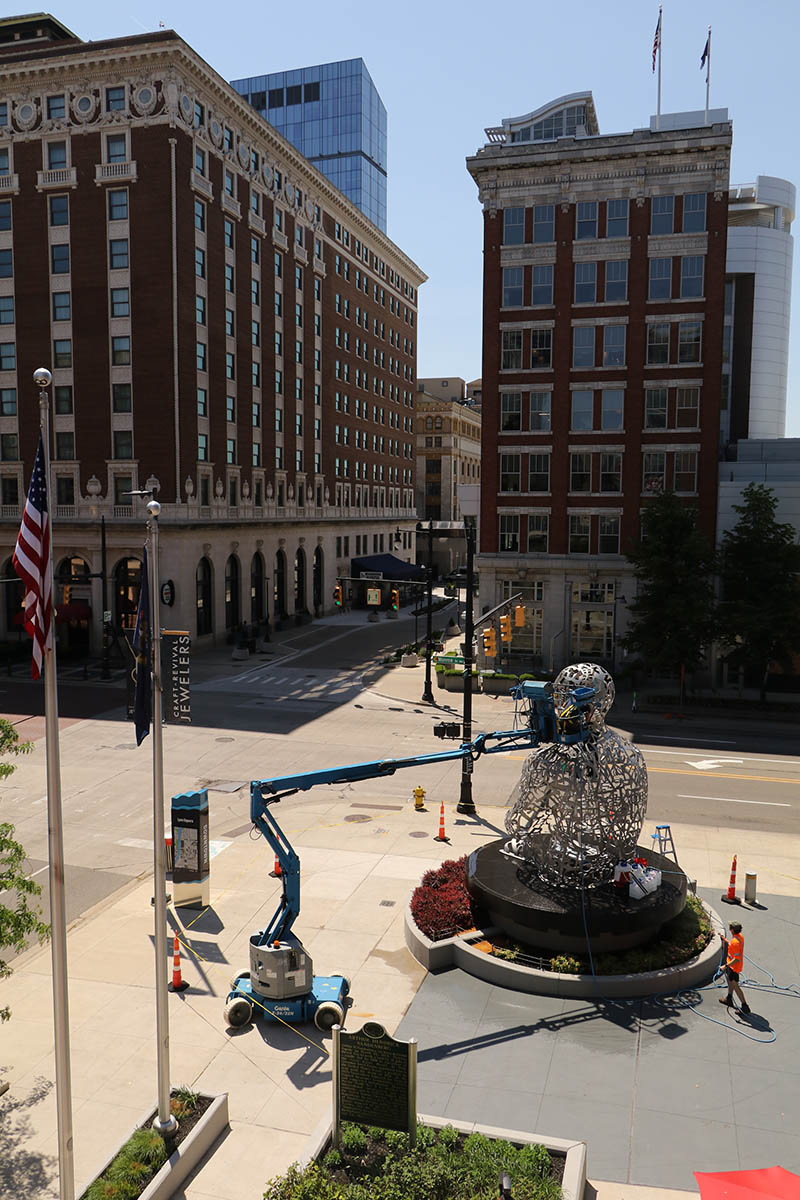
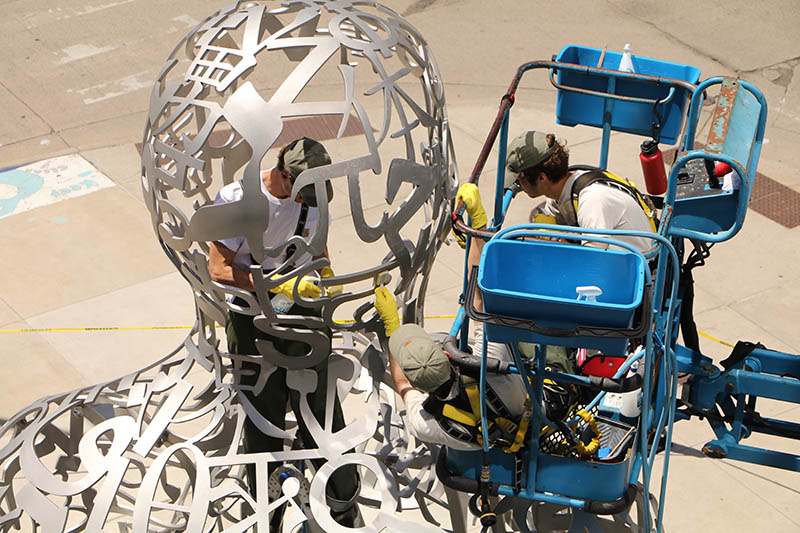
Step onto the Northeast corner of Monroe Avenue NW and Lyon Street NW in downtown Grand Rapids, and you’ll find a widely beloved sculpture: The Four Elements by world-famous artist Jaume Plensa. This work of art is created using metal letters and elemental symbols (air, water, fire, earth) to form a human figure. Many people pass this sculpture daily and marvel at its beauty, but two Aquinas Saints have a unique connection to it.
This summer, Aquinas senior Sawyer Shank has joined AQ alumnus Dale Domer ’15 to clean and preserve the sculpture for future generations.
The Capstone Class that Connects
There’s a common caricature of artists that comes to many people’s minds: a Van Gogh-esque
figure, wearing a long brown coat, covered in paint splotches, and not a dollar to
his name.
These are not the artists you will meet at Aquinas.
At Aquinas, one of the two capstone options for an art degree is called “Professionalism” and involves structured experiences centered on the profession of being an artist: digital documentation of artworks, portfolio and resume preparation, discussions with art professionals, and learning techniques for mounting an exhibition. Also of note is the substantial writing component of this course, which ensures graduates are prepared to communicate about their work in professional contexts.
At its heart, this culmination of studies for an art degree at Aquinas is not just about getting a job. It’s a foundational learning step that connects young artists to a thriving alumni network that will mentor them as they enter their professional lives.
Sawyer shared how his professor, Chris LaPorte ’96, brought his class to several locations around Grand Rapids to hear from AQ alumni and explore the many forms success can take. Dale Domer ’15 was one of these alumni whom the class visited as part of this capstone.
 “Yeah, that’s how we were connected… Through Chris Laporte,” Sawyer added. “Chris
was Dale’s prof when he was here. I was actually editing photos when I got an email
from Chris. He goes, ‘Hey, Dale Domer needs help this summer.’ He sent me his contact
information in the email, so I reached out to him. A couple of weeks went by, and
I drove over to his studio down on Godfrey. And yeah, we had a super chill conversation.”
“Yeah, that’s how we were connected… Through Chris Laporte,” Sawyer added. “Chris
was Dale’s prof when he was here. I was actually editing photos when I got an email
from Chris. He goes, ‘Hey, Dale Domer needs help this summer.’ He sent me his contact
information in the email, so I reached out to him. A couple of weeks went by, and
I drove over to his studio down on Godfrey. And yeah, we had a super chill conversation.”
Dale is a sculptor and painter, a professional art handler, and a fine art consultant. As a student, he did a Sculpture and Exhibitions internship at Frederik Meijer Gardens from 2013 to 2015, where he was first exposed to sculpture conservation. That was also where he became acquainted with Jaume Plensa’s work, well before the installation of “The Four Elements” in 2021.
“I got such invaluable insight into what it actually looks like to work with people and collect a paycheck from a job centered in the arts,” shared Dale. “Whether you end up doing something hands-on like sculpture conservation, or working in an arts-centered legal practice, or any number of jobs within a museum or similar institution, I think having early hands-on experience gives you that deeper understanding of how it all works together.”
Today, Dale continues this work as a contractor. He owns MOA Art LLC, an art studio in Grand Rapids that provides a range of services to support and care for art collections.
“Seeing how Dale operates and then having that connection with Aquinas and with Chris LaPorte, it’s definitely been very encouraging to me,” said Sawyer. “This is something that works. Just being there, boots on the ground, seeing it for myself, it definitely reaffirms what Chris was teaching us.”
A Summer with Sculpture
So, what exactly does working with sculpture look like? Surprisingly, it's more than
meets the eye. When working to preserve any sculpture at this level, the first requirements
are a proper attitude and preparation.
“Our engagement starts with respect and appreciation for the role we serve.” Dale shared. “From there, our team benefits from a strong network of support that connects us with industry experts and all the resources we may need. Together, we form a conservation plan that ensures the outcomes we’re all after.”
Dale explains how his team carries out a specific procedure, carefully developed by Plensa’s studio in Barcelona, the Richard Gray Gallery in Chicago, and William’s Art Conservation Inc. in Los Angeles. The conservation effort can be broken down into five phases:
 Initial condition inspection and reporting
Before Sawyer ever joined the project, Dale and his team had already established a
detailed conservation process. During their first year working on the sculpture, they
hired a photographer to document its condition and track changes over time.
Without this visual record, they cannot confidently determine whether observed issues represent ongoing patterns or isolated incidents. Their main goal is to monitor the levels of activated rust on the surface while ensuring that the methods used to address any issues remain safe and appropriate.
Surface cleaning and preparation for chemical treatment
Once Dale and his team have documented the sculpture’s condition and confirmed their
plan, they begin removing the dirt, pollutants, and other contaminants that can lead
to rust. It’s a critical step that helps protect the sculpture from long-term damage
while preserving the artist’s original vision.
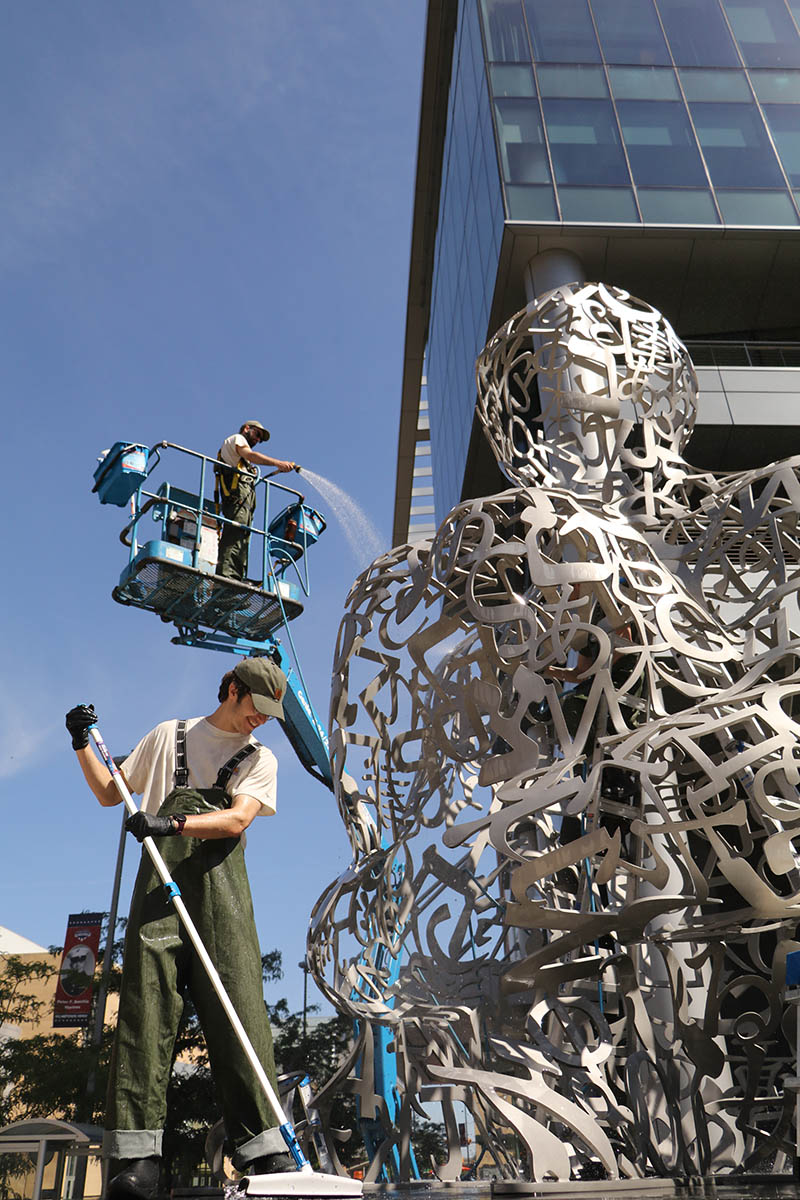
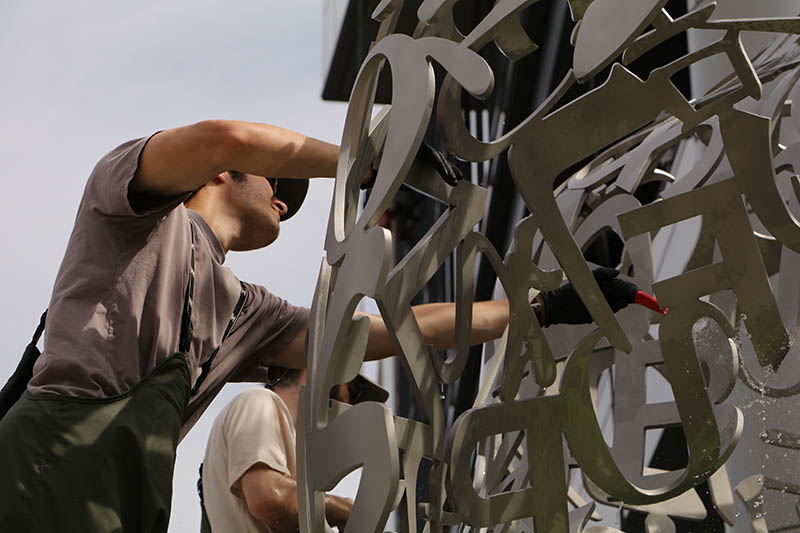
“Sawyer joined our team at this stage, where we began the process of gently washing every inch of the sculpture to remove airborne pollutants and to get rid of anything that might disrupt the chemical cleaners we use later,” Dale explained.
This stage isn’t always easy. As the snow melts and temperatures start to climb, salt and iron from downtown Grand Rapids’ winter roads can settle on the sculpture and cause rust to form. The team wants to remove those pollutants as soon as possible, but the chemical only works once it’s consistently warmer than 65 degrees. That means Dale and his team have to keep a close eye on the forecast and wait for the right weather before getting started.
“That week was interesting because it was still in the transition from cold to warm,” said Sawyer. “So it’d be a nice day one day. The next, it’d be cold and rainy.”
Corrosion mitigation by chemical treatment
For the next two weeks, the team applied a citric acid-based treatment to gently remove
corrosion from the sculpture.
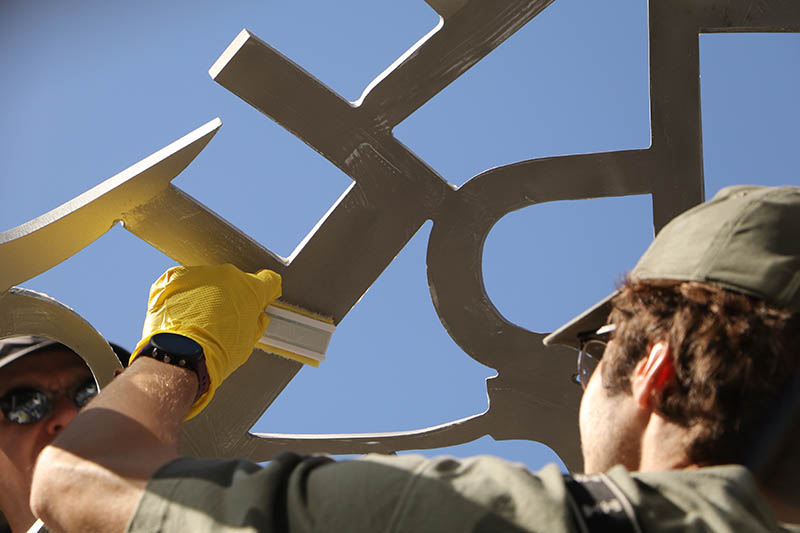
Sawyer explained that he and the team sprayed this chemical onto a brush and applied it to one area at a time, leaving it there just long enough for it to “bite.” Application of the acid is slow and closely measured. Since the acid is colorless and can permanently etch into the surface and cause damage if left on too long, working in small, controlled sections is essential.
“I’ve learned a few times over the course of this [project] that temperature makes a huge difference in chemistry,” said Sawyer. “Even if it’s just ten degrees, it can make the difference between the chemical working in half an hour versus an hour.”
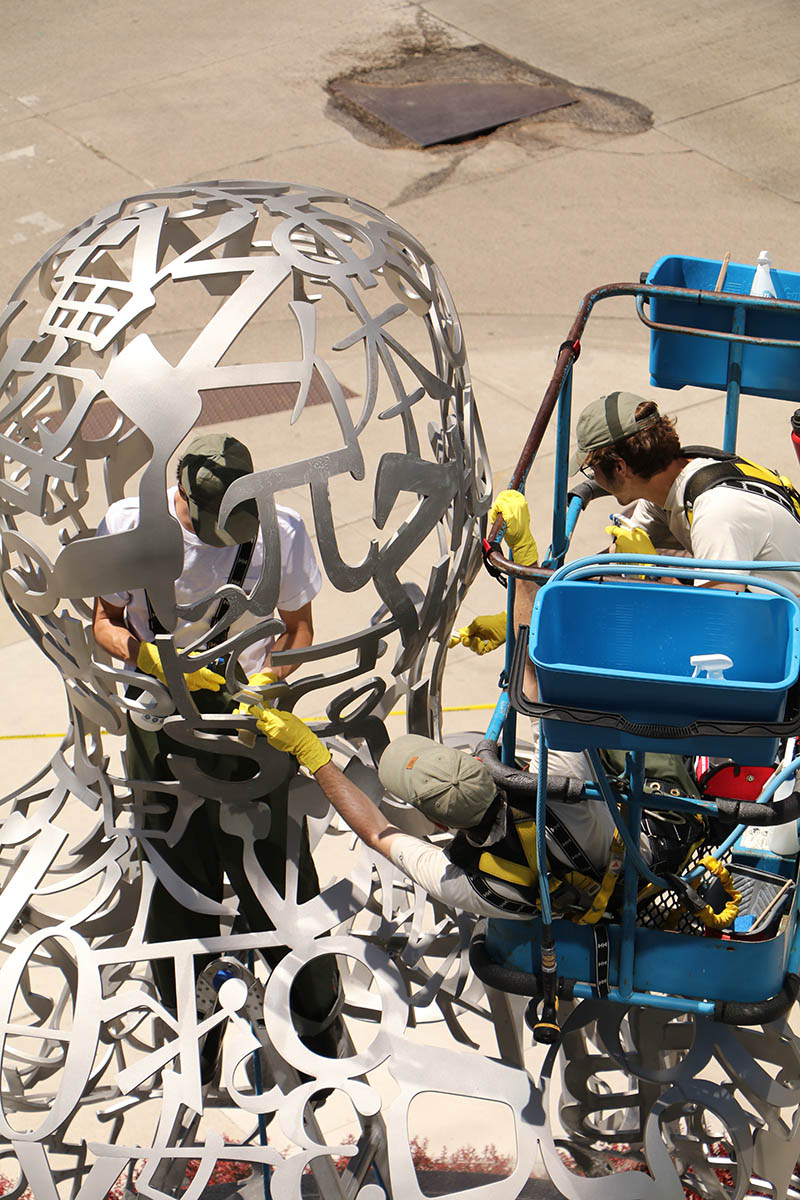 Surface cleaning and complete removal of chemical treatment
Once the chemical treatment was complete, Sawyer and the team thoroughly flushed the
sculpture with distilled water. This simple step is crucial. Distilled water absorbs
the trace amount of acid that might be left on the sculpture. Hundreds of gallons
and experienced eyes are essential for ensuring the entire sculpture, its base, and
the surrounding display are completely free of any acids.
“I was deputized to set up and tear down our hoses,” shared Sawer fondly. “You could say I was the hose master.”
Condition inspection and documentation
As their team completes the final phase of conservation, the evidence of weeks of
ongoing care can be fully appreciated. “This is the most gratifying part for me,”
Dale recalls. “Coming back to the sculpture, up close and without all the PPE, to
photograph and document all of the issues being fully resolved, is truly a great reward.”
Just as it began, the conservation effort concluded with thorough photographic documentation of the sculpture and an updated condition report, bringing the project full circle. “It’s absolutely a team effort,” says Dale. “And we all share the satisfaction of a job well done.”
Beyond The Four Elements, Sawyer will continue working with MOA throughout the summer and into the fall, gaining experience with a wider variety of conservation projects.
Exploration Beyond the Elements
Sawyer and the team will soon take on a sculpture by Dale Chihuly, owned by Steelcase, which is currently in the coordination stage.
“It’ll be so different from what we’ve done with the Plensa sculpture. Both sculptures are sited outdoors, but one is made of steel, and the other, Chihuly, is blown glass. Both are monumental in scale, but Chihuly’s work is made of a material that’s pretty much the polar opposite of stainless steel. It will be a very different approach,” Dale shared.
The Chihuly sculpture, which is roughly 500 individual components of blown glass, joined with braided wire to a suspended stainless steel armature, will require immense risk mitigation.
Even though Dale has worked with many others on conservation projects— former colleagues and various people within the art community— Sawyer is the first Aquinas student he has hired directly. He is adamant that Sawyer has access to a wide variety of conservation experiences this summer and is dedicated to making this the best learning experience it can be.
He has shared that Sawyer is exactly what he looks for in younger employees: “People who are driven and curious and want hands-on experience. Maybe it sounds simple, but just having somebody eager to understand what’s needed and then work hard to fit that mold has just been so refreshing. He’s worked with a couple of people on my team who have said, ‘Oh my gosh, he’s a mini-me of you.’ We’re cut from the same cloth. I think he and I have a lot in common, and our experience at AQ just gave us an easy on-ramp into communicating with each other.”
Dale was grateful for the opportunity to highlight Sawyer’s experience and the possibilities available to students pursuing careers in the arts.
Overall, “I think Sawyer is an all-star. He’s a great athlete. I can tell already that his passion for swim and dive certainly extends beyond the pool. He just exudes ‘the Aquinas athlete’. He’s so deserving of a highlight.”
He also expressed that the arts truly deserve recognition as a valid career path.
“There’s something so grounding that I experience working in the art world that I would love to share with people who have their fears about committing their education to the arts, afraid that they might not find a job. The ambiguity of the art world can often leave people with a default sense that it’s just not safe to study art. But you know, we’ve got incredible artists around the globe that need support. And my company has been developed and fine-tuned to reach those artists and understand what their needs are.”
“There really is such a great professional life to enjoy in the arts.”
What Happens Outside the Studio Inspires What Happens Inside the Studio
Through the culmination of these experiences, Sawyer has learned a great deal about
how he navigates life as an artist in many unexpected ways. Working around world-class
sculptures, surrounded by other creatives, has inspired his own creations— and he
has had a blast in the process.
He shared that he’s been working on a project that has allowed him to experiment with the complex network of pipes, drawing inspiration from working with the hoses, and to explore how those lines and textures interact with space.
“I wouldn’t have even thought of that if I weren’t working with the hoses,” said Sawyer. “Chris has really driven this point— and so has Dale, for that matter— that artists have a day job, and a lot of what you do outside of the studio influences what happens inside.”
He explained that it has been much easier to make art for himself when the source of it is drawn from his real-life experiences. The shapes of those hoses teach him what to commit to paper when drawing, and he can bounce ideas off his like-minded coworkers.
In the future, Sawyer hopes that he can keep working in similar positions, where he can engage with art, around other artists, and continue to hone his own skills simultaneously.
“To any person coming into college kind of at a loss for where you want to end up, I would say, talk to your professors, man. Don’t just show up and check off boxes; actually take the time to get to know your instructors,” said Sawyer, reflecting on his experiences. “Because of the connection I made with Chris LaPorte, I was able to make this connection with Dale Domer. And I’m realizing this is something I can enjoy, and I can continue to do it. Regardless of where I go from here, I can take it with me. That wouldn’t have happened if I hadn’t made that connection with my professor.”
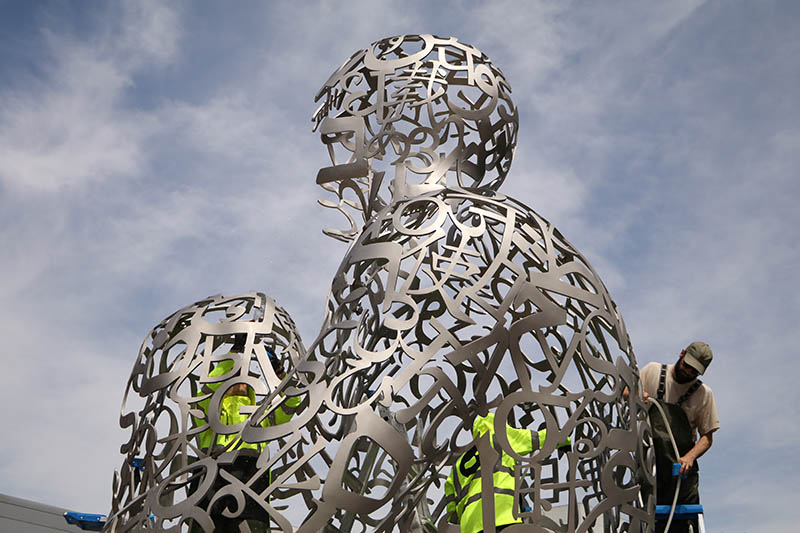
All photos are courtesy of Chuck Heiney.