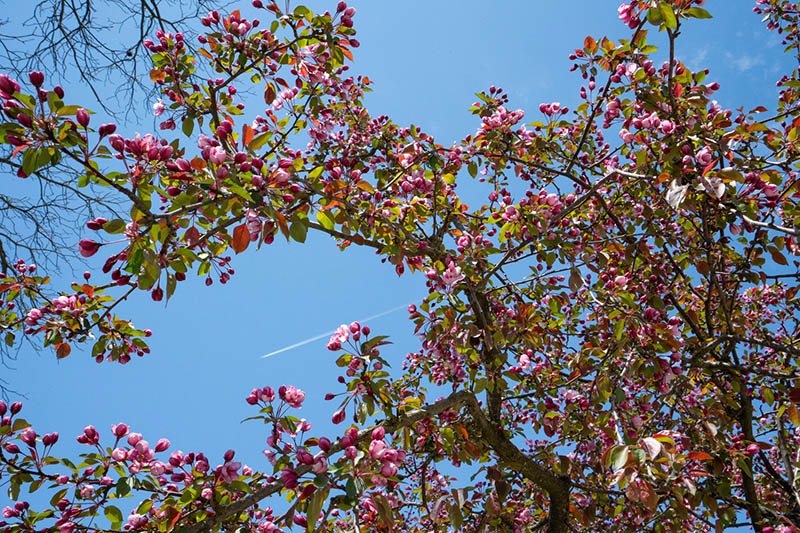
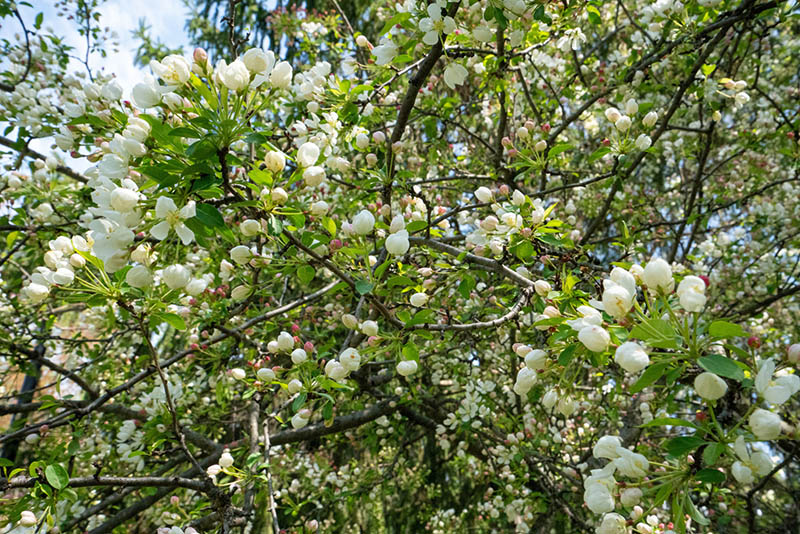
It’s a beautiful spring day, and over 10,000 trees spring up from Aquinas’ grounds. The Coldbrook Creek rambles just beyond the science building, and birdsong teeters high in the bristling white, pink, and green leaves. Beneath it all, the low hum of a golf cart lingers like a gentle drone, a quiet chord threading through the natural music. And if you’re very lucky, you’ll have a guide beside you—someone who can help you trace the vast history of this enduring place. This is the Aquinas tour, the first scene in many of our Saints’ stories.
While it often serves as an introduction to campus life, in this case, it also reflected something more enduring taking shape here on campus. The mantle of Director of the Center for Sustainability has been passed to Jen Howell, who has already begun making an impact.
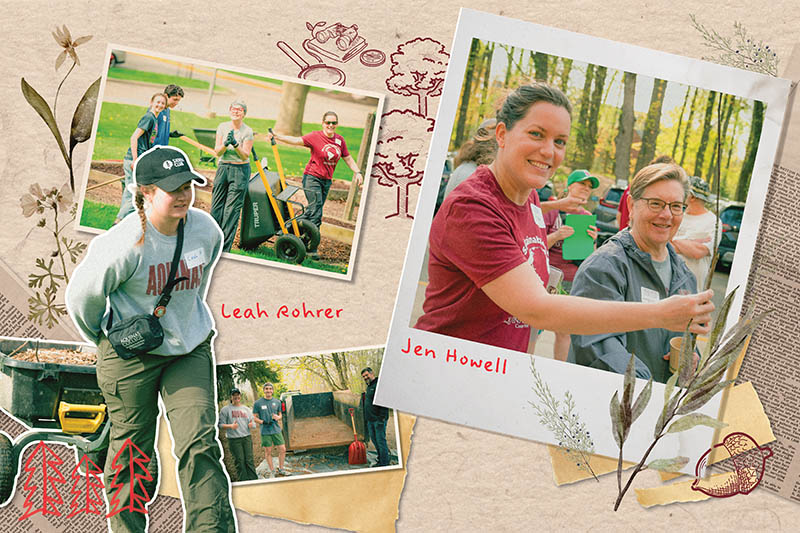
After her first few months, Jen has expressed how deeply moving it has been to witness the years of hard work individuals have already spent on caring for Aquinas’ natural campus. She has shared how instrumental her two student workers, Leah Rohrer and Madi Rempalski, have been in keeping the Center up and running in the hiring interim and filling her in on the day-to-day operations. She is grateful for the strong foundation her predecessor, Jessica Eimer Bowen, has left her. And in this spirit, she has committed herself fully to “environmental stewardship,” beginning by drawing more people onto campus to experience its beauty and to better engage with it as a “living laboratory.”
Under her guidance, Aquinas has officially achieved accreditation as a class II urban arboretum.
“Back to Ryan Wendt taking me on my tour of campus,” Jen shared, “I’m looking around and thinking... this is already a tree museum. They have everything they need. They just need someone who is going to walk them through the process.”
A Relationship with Nature Built on Care and Action
Jen has known since childhood that she wanted to make a tangible difference in the
natural world. Her journey to ecology has built upon this lifelong dream. When asked
about her motivation, she shared the following anecdote:
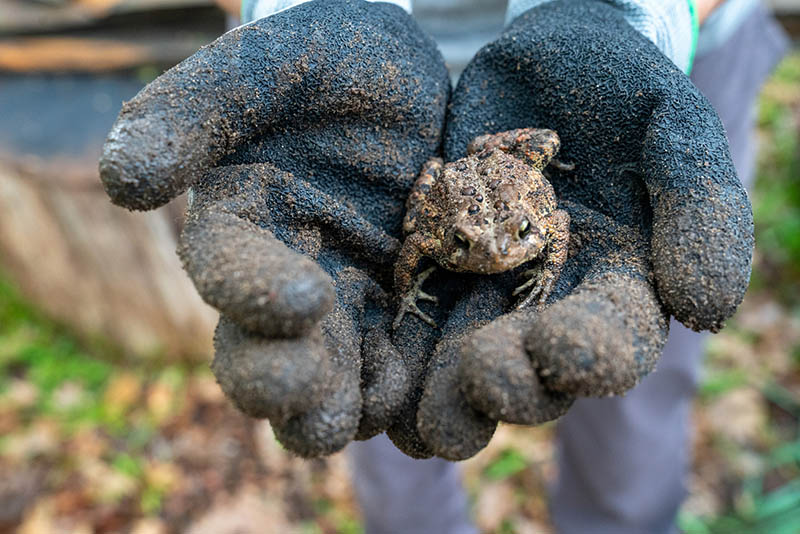
I was raised by a family that tolerated my love of insects and frogs. We moved right before the school year started, so I knew nobody. And my parents were fixing up an old house, so I had plenty of time on my hands and nobody to spend it with. I just started wandering the woods behind my house, and I stumbled upon what looked like a giant puddle. And I started looking at it. I spent some time with this puddle and realized there's a lot more going on here than meets the eye. I started seeing spring peepers hopping around in there, and salamander larvae swimming about, and then the various life forms that exist in a pond, like macroinvertebrates and tiny little clams. That small ephemeral pond became MY pond over the years, and I remember distinctly the day that the dirt bike boys came through my pond, and that changed me— to see there were these vulnerable creatures that couldn't escape their destruction.
I would be the weird fourth grader out there picking up trash and scooping up 5-gallon buckets teeming with frog and salamander larvae to take them back to my home, where I could offer them protection so they could develop into adulthood. In spite of appreciating a tidy home, my patient parents tolerated the mess of me bringing fresh pond water and pond muck to feed the metamorphosing frogs and salamanders each day. And when I felt they were strong enough to fend for themselves against the tires of the dreaded dirt bike boys, I released them to their proper home. That's really when I got connected to nature and understood clearly the impact that even one person can have, negatively and positively. I felt like I was making a difference out there as a little kid with my trash bags and 5-gallon buckets. That's when I realized that I want to do something that could tangibly improve the condition of the world.
This priority has followed her throughout both her academic and professional life. She had opportunities to enter research programs that would have allowed her the ability to delve deep into a single type of organism, like butterflies and sea lampreys, but this sort of research wasn’t as appealing to her. She questioned whether or not she could make the kind of positive impact she had hoped for if she had taken these routes.
Instead, she chose to plant her boots in the ground and pursue other opportunities. She took an unexpected role in working with agricultural landowners, persuading them to adopt “best management practices.” These included using cover crops, conservation tillage, implementing riparian buffers, using fencing to exclude livestock from streams and manure management, and much more.
“That was what was really inspiring to me,” Jen added, “realizing that I could do something that could connect people to nature in a positive way. And here I am, still trying to do that. It started with the old frog pond.”
Looking to the future of sustainability at Aquinas, Jen expressed how incredibly grateful she feels for the hard work that has already been put into maintaining this campus. She is grateful for the strong foundation that Jessica Eimer Bowen left, and for her student worker, Leah, who had preserved so many of the behind-the-scenes processes for her. She stressed that her work will not be an overhaul of the Center; rather, she intends to “build on what Jessica created here over her long career.”
She shared that the main update will be in shifting the focus to integral ecology.
“That is just really focusing on the human component of what we could be doing here on campus,” she explained. “Instead of just diverting waste from the landfill, the focus is more about moving forward— how do we actually do positive things instead of just reducing the bad things? How do we, for example, increase biodiversity on campus? We can start showing in real ways that we are contributing to increasing biodiversity in our little 111-acre woods. And how that can be a meaningful impact, especially when you consider the seeds you plant in the students that they take with them wherever they go.”
A Thriving Student Culture of Agency and Initiative
Leah Rohrer stands as a primary example of one of these seeds who has grown in her
love of the Earth throughout her time at Aquinas. She headed the Center for Sustainability
for approximately eight months between Jessica’s departure and Jen’s hiring, a remarkable
feat for any individual, especially so for a student worker.
When she toured campus, long before she knew she would find her home here, one detail especially stood out to her: how the wood cut down during the construction of Albertus Hall’s second wing had been repurposed for tables and other parts of the building, remaining a visible part of campus life. “I thought that that was really impressive,” she explained, “Not really something I knew I was looking for, but definitely a draw.”
In the absence of a director, Leah focused her time on collecting and organizing the various learning and operational materials for the Center. She maintained the social media. She organized waste diversion training materials, especially those used during new student orientation. And most importantly, she documented the longstanding processes so that the next director could keep the momentum without letting central initiatives die.
“Leah has done a great job of extracting all that and putting it in a way that the rest of us can access.” Jen shared. “I’ve even heard Brian Matzke mention that Leah is the face of sustainability as far as he’s concerned.”
Along the way, Leah found support across campus. “I had the Provost Office, and then I also had Hannah Bechtold to help guide me through some of those tasks that I had to coordinate with the different offices across campus,” she stated. As she moved into the fall semester, she found help from her fellow student worker, Madi. They shared tasks like social media management and ran regular events, such as the plant sale and the tree tours with Ryan Wendt.
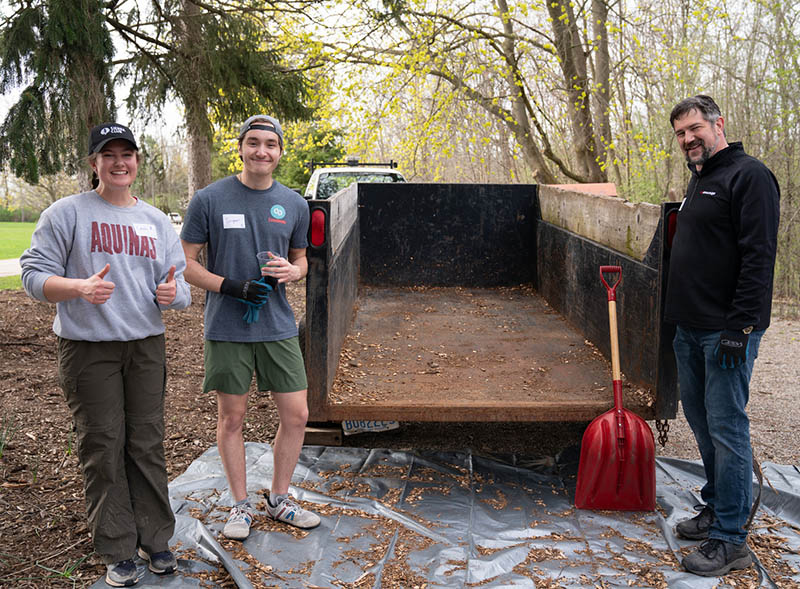 When asked about her favorite memory at Aquinas, she replied, “Before I was with the
Center, I got to be a group leader for the We All Live Here Service Day in 2024. We
went over to Marywood, and we did the woodchipping. It made my day so much better
being outside in the morning for a few hours, doing some physical labor, and talking
with people about sustainability. It was wonderful.”
When asked about her favorite memory at Aquinas, she replied, “Before I was with the
Center, I got to be a group leader for the We All Live Here Service Day in 2024. We
went over to Marywood, and we did the woodchipping. It made my day so much better
being outside in the morning for a few hours, doing some physical labor, and talking
with people about sustainability. It was wonderful.”
Leah Rohrer is one of our 2026 graduates. She has just recently been named the winner of the Monsignor Bukowski Award, named in honor of the visionary first President of Aquinas College. It stands as the highest honor bestowed upon a graduating senior. The ideal recipient is profoundly committed to leadership, service, and academic excellence—all characteristics that Leah humbly embodies.
A Living Laboratory of Community and Conservation
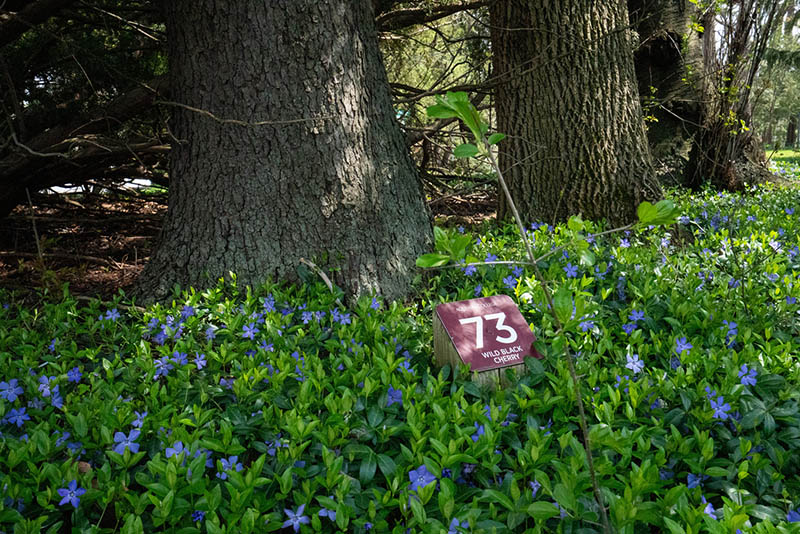
To be an arboretum, there are a few requirements: the trees must be identified and
marked, the arboretum must have more than one public outreach event in a year, it
must have a tree map that shows where visitors can find each tree, and it must have
a forest management plan.
Aquinas has over 100 marked species, qualifying for level II.
 One initiative the college has been pursuing for several years is to collect and care
for every species of tree native to Michigan. Aquinas plants a new one each year.
Currently, the college only lacks five: the striped maple, the black maple, the mountain
maple, the black spruce, and the jack pine, which — Jen has expressed — is fairly
controversial. “Some people will say we cannot have it on campus, and I would argue
that we just need to amend the soil, like a whole lot. And then we should put up a
sign that tells our guests that this exists here only because we completely changed
the soil, and to not try to grow it in their yard. It just needs sandy soil.”
One initiative the college has been pursuing for several years is to collect and care
for every species of tree native to Michigan. Aquinas plants a new one each year.
Currently, the college only lacks five: the striped maple, the black maple, the mountain
maple, the black spruce, and the jack pine, which — Jen has expressed — is fairly
controversial. “Some people will say we cannot have it on campus, and I would argue
that we just need to amend the soil, like a whole lot. And then we should put up a
sign that tells our guests that this exists here only because we completely changed
the soil, and to not try to grow it in their yard. It just needs sandy soil.”
In addition to featuring native trees, the collection includes 36 memorial trees and a variety of striking exotic species, such as Dawn Redwood (Metasequoia glyptostroboides), Ginkgo (Ginkgo biloba), Purple Beech (Fagus sylvatica), and Saucer Magnolia (Magnolia soulangiana).
As for the educational requirement, Ryan Wendt — Aquinas’ campus historian — has offered as many as 70 plus tree tours in a year. In 2024, which was scaled back from normal, he did 56 tours, bringing in 529 visitors. Many of these visitors were students in 7th and 8th grade, but they are open to all ages.
Aquinas also offers two beautiful maps that allow visitors to see the trees at a glance. There is a printable tree map, and there is also an interactive tree map that one of our retired professors, Dr. Mary Clinthorne, and her Geography and Environmental Studies students made years ago.
There already existed a formal tree care guide and a forest management plan. “I literally just had to go through the application process and share the links to everything we already had,” explained Jen. “I’m hoping that the people who did all this work before me just feel like this is a pat on their back.”
Be Part of What’s Growing
You don’t need to be a student or professor to enjoy the arboretum. Whether you’re
an alum, a friend of the college, or just a fan of trees, there’s space for you here.
“That’s the main objective,” Jen expressed. “If we can get people experiencing nature, then I think that they are bound to want to develop that stewardship towards caring for the planet around them.”
EXPLORE THE AQ URBAN ARBORETUM SEE PHOTOS FROM OUR 2026 “WE ALL LIVE HERE” DAY OF SERVICE